
The Robots Are Coming — To make You Creative

The AI Revolution has created a palpable fear that ”The robots are coming to take your jobs!”  Studies conclude that roughly half of present jobs could be lost to automation, even professional work, possibly leading to mass unemployment and social upheavals 

TechCast asked our thought leader-experts to forecast the future distribution of jobs across the occupational spectrum for the year 2030. The results below tell a different story that opens the way to a creative society.


Results and Conclusions: Muddling Through

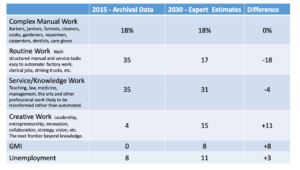
Results are tabulated below and show that the majority of experts believe that a reasonable path can be found through this difficult transition. We call this the “Muddling Through Scenario.” This is a “middle” scenario in which an organic combination of market forces produce new creative jobs and government support offers GMI benefits, containing unemployment to tolerable levels.

TechCast experts collectively judge that humanity will find its way safely through the coming AI/robotics crisis as the world reaches a more fully automated stage of development about 2030. Automation is likely to eliminate about 22% of routine jobs but the loss is likely to be compensated by roughly 8% of workers gaining a guaranteed minimum income (GMI) and roughly 15% finding new jobs in “creative work.”  


Expert Survey Results for OECD Nations in 2030 (N = 53)
 

The Possibility of a Creative Society

This is a modest study, and many complex issues are involved, yet we think this forecast provides useful insights into how the AI issue can be resolved. 

We conclude that government support and innovative enterprise could absorb this AI threat and turn it into a new domain of creativity.The adoption of GMI and the growth of new creative jobs are likely to keep unemployment contained at 11 percent or so, which would be bad but not a major crisis. Furthermore, the widespread use of AI should increase the level of knowledge and intelligence to unprecedented levels, fostering a society of creative change and understanding.

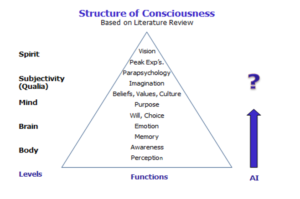
The key is to recognize that AI can automate routine knowledge work, but there exists a huge unexplored economic domain beyond knowledge—creativity, entrepreneurship, vision, collaboration, diplomacy, marketing, supervision, and other higher-order functions that are uniquely human. See the figure, “Structure of Consciousness.” Advanced AI may be able to solve tough problems, but it cannot provide vision, purpose, imagination, values, wisdom, and other capabilities that are essential for sound leadership and tough choices.
 

Intelligent machines are likely to take over routine service and knowledge tasks, but the technology will remain limited and people will always want a real person to provide human contact and handle tough issues. Staff is growing rapidly in universities, hospitals, research institutes, and other advanced settings for these reasons. The service and knowledge work sector could grow to 50−60 percent by 2030.

In the end, rather than diminishing people, the net effect of AI may be to enhance the value of these higher-order talents that are a unique gift to humanity.This conclusion may seem contrary to many who are convinced a disaster looms ahead. We respectfully suggest that, yes, the robots are coming to take your jobs, but more creative work and better support can also foster a more innovative, prosperous and thoughtful civilization.

This article is a short version of the AI and Future Jobs published in Foresight: The journal of future studies, strategic thinking and policy.

Andrew Micone, USA

PROFILE SUMMARY

Technical Architect & Strategic Foresight consultant focusing on Health Informatics and Information Security.
andy@micone.org

Patrick McCann, USA

PROFILE SUMMARY

I am a passionate results-oriented pharmaceutical industry professional with a unique background in Operations, Information Technology, and Science. In the most current iteration of my career at Pfizer, I deliver business performance insights to senior decision makers. Prior to this, I successfully led continuous improvement initiatives in the Drug Discovery, Clinical Development, and Regulatory divisions as an internal consultant in Bristol-Myers Squibb’s R&D Operations department. In the past, as an Information Technology professional, I successfully managed large-scale multimillion-dollar capital projects, managed and developed support staff, and integrated M&A partners. As a scientist, I delivered important insights into the molecular structure and lifecycle of pathogenic human viruses while generating key data for transitioning compounds.

I am recognized for being a strategic thinker with the ability to link strategy and tactics, implement change, and deliver value. My skills include:

● Cross Functional Initiative & Project Management
● Process Improvement and Ownership
● Organizational Diagnostics & Improvement
● Change Agent (SWITCH)
● Voice of the Customer
● Strategy Development & Implementation
● Competitive Intelligence
● Systems Thinker
● Industry Benchmarking
● Big Data Scientist: Analytics & Visualizations
● RFP/RFI vendor selection & management
● Personal Productivity (GTD)

My educational background includes an M.Sc. in Molecular Biology and an MBA in Marketing.


pjmccann3@yahoo.com

Péricles Purper Thiele, Brazil

PROFILE SUMMARY

Administrator, Master and Doctor in Regional Development.
Effective Professor at the Instituto Federal de Educação, Ciência e Tecnologia Sul-rio-grandense – IFSul (www.ifsul.edu.br).

Member of the IFSul Research and Innovation Chamber.
Alternate Member of the Editorial Board of IFSul Magazine.
Opinionist of Thema Magazine of IFul.
Ad Hoc Public Caller IFFar – IFRS – IFSul – IFSC – IFC – IFPR No. 01/2017.

Participant of the Plataforma (Rede) de Intercambio de Aprendizajes “Prospectiva sin Fronteras” – ILPES/CEPAL.
Member of the research group GEDER – Grupo de Estudos e Pesquisas em Diversidades e Especificidades Regionais-IFTO.

Organizer of the Seminário de Empreendedorismo e Associativismo IFSul (8 editions); of the Mostra de Trabalhos de Administração (4 edition); and the Feira de Negócios (6 editions).

SEBRAE / RS Consultant between 2004 and 2010;
Consultant for BADESUL External Projects for 3 years.


periclespurper@gmail.com

Rupam Shrivastava, USA

PROFILE SUMMARY

Mr. Shrivastava is a partner with ePlanet Capital, a global technology venture capital firm headquartered in Silicon Valley which manages assets over $750MM. His investment areas include TMT, Internet, Mobile, Artificial Intelligence and Machine Learning sectors. He has invested in the US, UK, Western & Eastern Europe, Middle East, India, Latin America and Africa. He was the founding investor in multiple Virgin Mobile businesses in Latin America, Middle East and Central & Eastern Europe. He also led the first investment in Singularity University along with Google and NASA. Prior to that, he was the founding member in Vodafone’s African operations where he helped launch businesses in multiple sub-Saharan countries. Mr. Shrivastava started his career as an investment banker with Dresdner Bank in New York where he worked on US-EU cross border M&A transactions. He holds a double MBA from Columbia University and University of California Berkeley, an MS in Computer Science from Massachusetts Institute of Technology and a B. Tech. from Indian Institute of Technology where he received the Presidential Silver Medal. He has published research in the International Symposium on Signals, Circuits and Systems; and the Society of Automotive Engineers. He is also a CFA, CAIA, FRM and CMT Charterholder.
rupam.shrivastava@gmail.com

Amy Fletcher, New Zealand

PROFILE SUMMARY

Amy is a political scientist and professional futurist currently based in New Zealand. Born in the United States, she earned her PhD in public policy and political science at The University of Georgia (1997) and worked as a legislative assistant on technology issues in the United States Congress before taking up an academic appointment at the University of Canterbury. She has published on science and technology policy, biotechnology and biomedical issues, and the social implications of technological disruption. She recently completed the postgraduate certificate in foresight at the University of Houston (2019) and is on the editorial board of the Politics and Life Sciences journal.
AmyFletcher@Protonmail.com

Burak Can, Turkey

PROFILE SUMMARY

Accomplished executive with strategic direction over ten years in various positions (founder, C and middle level manager, consultant, project manager, engineer) in ICT sector; efforts to develop and market our innovative solutions to clients. Implement road map for our blue ocean strategy in robotics. Oversees team development and vendor selection/maintenance for million-dollar operations. Managed the funding and investment processes for the growth strategy. Known for creating and implementing training that expands team member capabilities. Works with government, civilian, and corporate stakeholders.
burak@2cteknoloji.com

Xin-Wu Lin, Taiwan

PROFILE SUMMARY

Experienced Economic Research Fellow and Director of Taiwan Institute of Economics Research, with a demonstrated history of working in Policies for Government and Business. Strong professional and practical experiences in Innovation Policy, Entrepreneurial Policy, Business Model Innovation, Innovation Management, Emerging Technologies, Regulatory Compliance, and Antitrust Economics.
d11701@tier.org.tw

Arthur Shostak, USA

PROFILE SUMMARY

I was a founding member of the World Future Society, a frequent contributor to its magazine and presenter at its Annual Meeting (one of which I chaired in Philadelphia), and a co-founder and longtime leader of its Philadelphia Chapter. For many years I gave commissioned forecast talks for corporations, labor unions, and every level of government. Among my 34 books are many future-oriented ones.
arthurshostak@gmail.com

Jose Cordeiro, Venezuela

PROFILE SUMMARY

Cordeiro has been described as “a hopeless optimist always bursting with energy”.[who?][10] He advises audiences to “Forget flying cars and robot butlers… the future will be a far more interesting place”.[11] He views nano, bio, info, and cogno (NBIC) as being the four main technologies that “are pushing mankind into the post-human age”, and he predicts that “in the future we will be upgrading our brains every few years in the manner that we currently update our computer hardware”.[12]
In 2009, Cordeiro spoke at the European Futurists Conference in Lucerne about the concept of ‘Singularity’: “a not-too-distant moment when artificial intelligence overtakes the capabilities of the human mind – the point when we are going to merge with machines”. As a teaching fellow of the Singularity University, he added that “the purpose of Singularity University is to prepare humankind for this transformation”.[13]
Cordeiro coined the term ‘Energularity’ to refer to “the biggest change in the largest industry on our planet… the Energy industry’s shift from fossil fuels to solar, wind, geothermal or fusion”. He also coined the term “Benesuela” as a contrast to “Venezuela” in reference to the educational situation in that country.[4]
In a set of forecasts about Latin America in 2030, Cordeiro and the Millennium Project highlighted two extreme scenarios: “God is Latin American” and “Disintegration in Hell”.[14]
The New York Times has quoted Cordeiro as saying “The constitutional history of Latin America is the most convulsive in the world. Constitutions seem to have become like shirts, not even suits, which rulers put on and take off at their whim.”[15]
In line with forecasts by Ray Kurzweil that the Singularity will occur by 2045, Cordeiro predicts that “death will be optional by 2045”. This will take place “thanks to exponential advances in artificial intelligence, tissue regeneration, stem cell treatments, organ printing, cryopreservation, and genetic or immunological therapies that will solve the problem of the aging of the human body”.[16]
jose_cordeiro@yahoo.com